Air-Gapped AI Deployment Costs Broken Down by Line Item
A line-item breakdown of what an air-gapped AI deployment actually costs, covering GPU hardware, offline licensing, media handling, and ongoing maintenance.
The costly mistake is pricing an isolated AI build from on-prem reference numbers while ignoring the overhead the isolation itself creates: offline licensing, physical-media patch cycles, and cooling for GPU racks that draw several times what traditional compute does. Those are the lines that break budgets after signing.
An 8-GPU inference node sized to serve a 70-billion-parameter open-weight model is the reference build. The scope is a classified or regulated network with no outbound path to any vendor, priced in 2026 US dollars across a three-year horizon.
GPU Hardware Sets the Capex Floor
A new NVIDIA HGX H100 8-GPU server sits in the range shown in the figures below, and a serious inference cluster usually starts with two to four nodes for throughput, redundancy, and a cold spare. The underlying vLLM sizing math still governs how many nodes you need: concurrent requests and model size, not headcount.
Around the servers you pay for InfiniBand or 400 Gb Ethernet, high-performance NVMe storage, two management nodes, and out-of-band KVM. The specific premium an air-gapped buyer pays, and the one most reference bills of materials miss, is cold spares. No vendor can overnight a replacement past the perimeter, so a meaningful hardware spares buffer across GPU boards, PSUs, and switch optics belongs in the capex line from day one.
Licensing When There Is No Activation Server
SaaS and per-seat models assume a license or control plane can phone home. Air-gapped vendors instead issue offline license files or local license servers, and most price as site licenses rather than per-token or per-user subscriptions. That trades one variable, usage overage, for another: manual true-up cycles you cannot automate.
The recurring lines to budget annually:
- NVIDIA AI Enterprise per-GPU subscriptions, renewed with an offline entitlement file.
- Enterprise Linux and security-hardened OS entitlements for every host and management node.
- Vector database and retrieval infrastructure licenses.
- Open-weight model distribution and vendor support contracts where applicable.
- The governance platform that enforces policy on every inference and logs it.
Site license pricing is predictable, which is the point. Budget stability is the trade for the elastic economics of hosted APIs.
Power, Cooling, and Space at Rack Densities Most Facilities Were Not Built For
Dense AI racks draw a step change above the baseline most colocation contracts are written around, and the step-up drives both facility capex and recurring operating expense. The ranking below sets the three regimes a facility team has to design around. GB200-class systems also require direct-to-chip liquid cooling, which is not a standard inclusion in most data centers.
Leasing high-density colocation is the fastest path. The per-rack monthly delta between standard and AI-grade space is roughly the ratio shown in the gauge further on. Building inside your own facility means a one-time cost for the liquid-cooling loop, higher-amperage PDUs, and upgraded power distribution. A broader on-prem versus private cloud breakdown covers how these lines move when some tier of outbound connectivity is permitted.
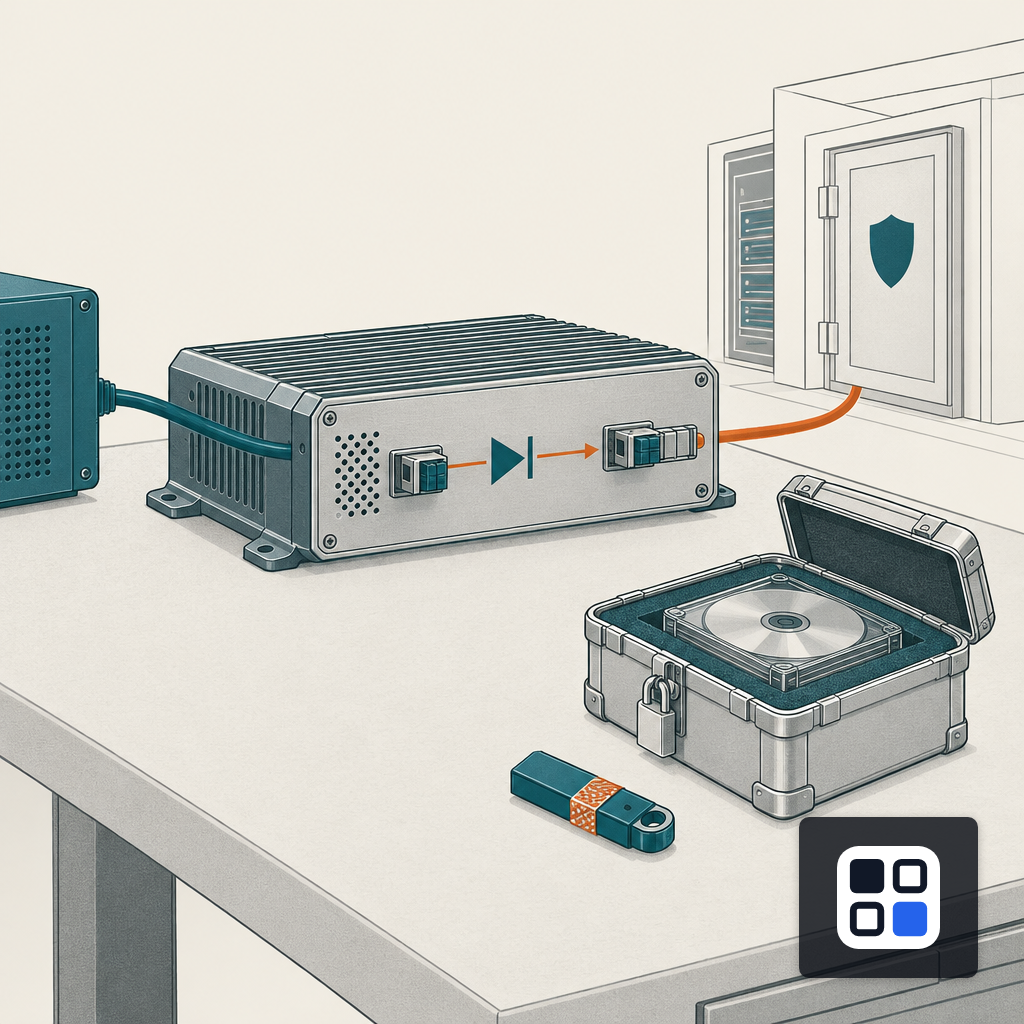
Updates and Patches Arrive on Physical Media
Air-gapped systems cannot reach vendor repositories, so patching happens through controlled transfer stations, data diodes, or signed removable media. Operationally that means a dedicated media-handling process, hash verification before import, staging mirrors inside the enclave, and a change window long enough to roll back if an update bricks a node with no path to a vendor engineer.
Plan for a half to one full platform-engineering role dedicated to the update pipeline itself. The scope is GPU drivers, CUDA, kernel patches, model weights, vulnerability fixes, and governance software. The compensating cost is time. Critical fixes that a connected enterprise applies within a day typically take weeks inside the perimeter, and the compensating controls that cover that window carry their own cost.
Controls the Budget Has to Pay For
Air-gapped NIST 800-53 implementations still carry specific control families that cost money:
- MP-5 (Media Transport): hardened couriers and chain-of-custody logging for every transfer.
- CM-6 (Configuration Settings): baselined images, signed drift detection, and change review.
- SI-2 (Flaw Remediation): the patch pipeline above, documented and auditable.
- SC-7 (Boundary Protection): the data diode, any one-way sync, and the controls around them.
On top of that, the NIST AI Risk Management Framework shown in the waffle below adds a parallel set of expectations that show up as internal audit, model evaluation, and incident-response spend rather than hardware. Signed, tamper-evident audit over every prompt, retrieval, and tool call is not optional in these environments. Data.co Control is designed for this layer: policy engine, classification, permission-aware retrieval, and audit against every AI interaction, deployed inside the perimeter.
A Three-Year Budget Frame
Pulling the line items together for a four-node, 32-GPU reference cluster serving a 70B model, the budget separates cleanly into capex and operations. Capex at year zero: GPU servers, networking and storage, facility fit-out or high-density colocation buildout, and the hardware spares buffer. Annual operations: site licenses across OS, GPU runtime, vector database, and governance platform; power for the continuous cluster draw plus the cooling overhead that scales with it; two to three platform-engineering roles; and the controls, audit, and media-handling program.
Three-year totals for a cluster of this size scale with the hardware and operations lines above. The dominant variables are owned-versus-leased space, how aggressive the update cadence has to be, and whether governance software is bundled with the inference stack or purchased separately. The infrastructure deployment model you choose, fully air-gapped, hybrid, or private cloud, moves which lines dominate, not whether they exist.
What Network Isolation Costs and Why It Is Still Worth It
The trade-off the isolation forces is efficiency. You give up the operational benefits of a vendor-managed update pipeline, elastic burst capacity, and per-token pricing that only charges for use. In return, no prompt, model weight, or audit trail leaves the perimeter, and every access decision is one your own controls made. For data classified at a level that will never see a hyperscaler region, that is usually the correct trade, and the line items above are the price of making it defensibly.
Samuel Edwards is Chief Marketing Officer and has spent 15+ years in technical SEO, content strategy and operations for organizations ranging from small businesses to Fortune 500 brands, including NASDAQ OMX, eBay and Amnesty International. At Data.co he writes about the operational half of data and AI: how datasets are described, classified and kept current, and the unglamorous failure modes — stale syncs, mislabeled fields, untracked lineage — that quietly cost the most.