vLLM GPU Sizing, Cost, and SLA Math for Private LLM Deployments
A sober look at vLLM GPU sizing, infrastructure costs, and production SLA design for private LLM deployments inside regulated enterprises.
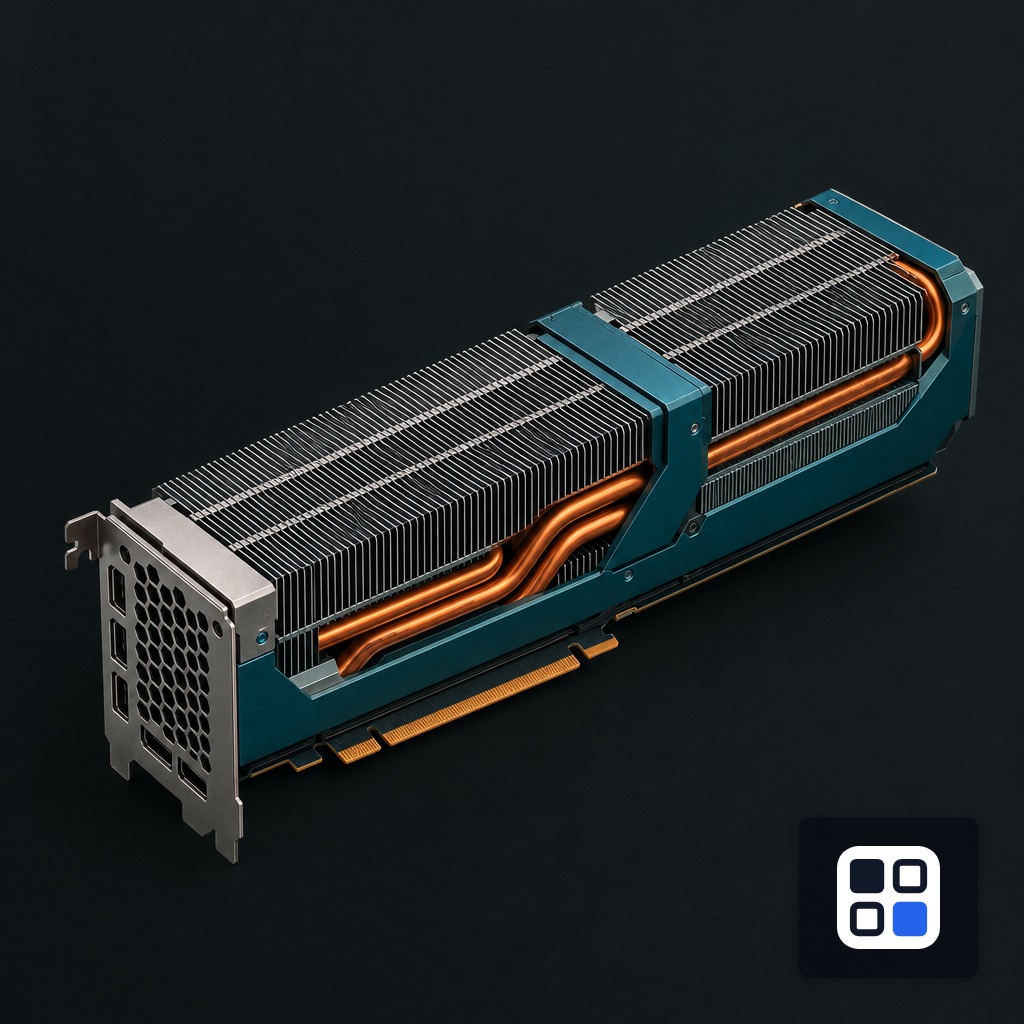
An H100 with 80 GB of HBM3 does not fit Llama 3.3 70B at full precision. The weights alone exceed any single H100's HBM3, which is why a credible private deployment lands on H200-class hardware or pairs H100s with tensor parallelism.
The useful numbers here are per-model VRAM footprints, vLLM throughput realities, hourly GPU economics, and the latency figures a security team can commit to in writing. Each has a defensible answer that survives a budget review.
The figures below assume vLLM, because its memory manager is the main reason an open-weight model can run under a published service-level objective at all, and because it is the layer most private deployments standardize on.
What vLLM Buys You, in Memory Terms
vLLM's contribution is PagedAttention, a memory manager for the key-value cache that borrows the paging idea from operating systems. In the original research, that change drops KV-cache waste from the 60-80% range typical of naive implementations to under 4%, and the project delivers up to 24x the throughput of HuggingFace Transformers and 3.5x that of Text Generation Inference on the same hardware. The gain shows up without architectural changes to the model, which matters when the weights have to clear a security review before deployment.
The practical consequence for sizing is that a server-side batch no longer stalls on fragmentation. Continuous batching, the scheduler sitting on top of PagedAttention, keeps the GPU busy by admitting new requests as generation for completed ones ends, rather than draining a fixed batch to its longest member. A single GPU that previously held eight concurrent 4K-context sequences can hold more than twice as many without the queue blocking on a free block that is not large enough. That shifts the bottleneck from memory layout to raw compute and memory bandwidth, which is where capacity planning should push it.
Sizing VRAM for a 70B Open-Weight Model
Weights are the floor of the memory bill; the KV cache and activation buffers sit on top. For a 70B model, native BF16 weights alone exceed a single 80 GB H100, so a defensible deployment is either one H200 with 141 GB of HBM, two H100s with tensor parallelism, or a quantized checkpoint that trades a measurable accuracy delta for fewer GPUs.
FP8 cuts the weight footprint roughly in half and brings a 70B model inside one H100 with headroom for a usable KV cache budget. FP4 goes further but needs an evaluation gate before it reaches production, since the quality hit is workload-dependent. For retrieval-heavy workflows, where most generated tokens are summaries of grounded context rather than open-ended reasoning, aggressive quantization usually survives the eval; for code and long-form reasoning, it often does not. The decision is not which precision is best but which precision clears the accuracy bar your users have in writing.
The Economics of a Private H100 Node
Hourly GPU prices from the three major hyperscalers are not close. The headline number for a single on-demand H100 can differ by a factor approaching two between AWS and Azure for list tiers, and more again when spot pricing is on the table. Those list rates assume you can actually get the hardware on demand, which in 2026 still means a reservation contract for anything above a handful of GPUs. At the scale of a reserved multi-node cluster, the spread is the difference between a budget that passes finance review and one that does not.
The on-prem comparison is not purely hardware. A Supermicro or Dell 8xH100 node with support, networking, and power runs several hundred thousand dollars of capital expense, before amortization, operations staff, and the real cost of keeping the cluster at the firmware revision the security team has signed off on. Break-even against on-demand hyperscaler pricing often lands between 12 and 24 months of sustained use, which is why the sensible comparison for regulated workloads is on-prem against private cloud rather than on-prem against the cheapest hyperscaler SKU.
SLA Numbers That Hold Up Under Audit
A production LLM SLA has three load-bearing numbers: time-to-first-token at the 95th percentile, end-to-end response time at the 99th percentile, and sustained output tokens per second per request. The three measure different failures. TTFT is user-perceived latency on the first word; inter-token latency governs how fluid the stream feels; p99 end-to-end is where the tail users complain to the security team actually live. The common mistake is to promise an aggregate tokens-per-second figure that averages away the tail, then field complaints every time an analyst submits a long-context query under peak load.
Public benchmarks give you a floor. The best measured providers currently land around 3.2 seconds end-to-end p99 and roughly 1.1 to 1.3 seconds p95 time-to-first-token on a mid-sized model. A private deployment has to beat or match that on the specific workload it serves, because the audience is internal and comparisons will be made. Signed audit on every call, which a hosted provider cannot give you, is where a governed private AI platform earns the premium.
The Compliance Overlay the Spec Sheet Ignores
Capacity planning that ignores regulation is a half-built document. Under the EU AI Act guidelines, general-purpose AI models trained with more than 10^25 FLOPs are presumed to pose systemic risks and face obligations covering model evaluations, incident reporting, and cybersecurity controls. Most open-weight models in use remain below that threshold, but a fine-tuned derivative can cross it, and the question of who counts as the provider after an internal retrain is not resolved by reading the model card.
Enforcement teeth arrive on 2 August 2026, when the European Commission can directly fine providers of general-purpose models through its AI Office. A serving stack has to produce evidence suitable for that regime: who prompted the model, with what retrieval context, under which policy, and what the model returned. If the inference layer cannot answer those four questions for every call, the throughput numbers in the capacity plan are beside the point.
Where the Private LLM Budget Earns Its Keep
The number your CFO is paying for is not peak tokens per second. It is the committed p99 under worst-case concurrent load, with a signed audit record behind each response, on infrastructure the security team already has a threat model for. vLLM, open-weight models, and H100-class hardware make that number reachable; policy, identity, and permission-aware retrieval make it defensible.
The question worth putting to any vendor or internal team pitching a private LLM is this: at what measured p99 latency, on which specific model and hardware configuration, for how many concurrent requests, and with what per-call audit record do you commit to serve the production workload? A good answer names the GPU count, the quantization, the vLLM parameters, the benchmark harness, and the retention policy for the audit log. An answer that gives you a tokens-per-second headline and a slide about enterprise-grade capability is not an answer.
Eric Lamanna is Director of Business Development at Data.co, where he works with the teams who have to live with an AI deployment after the demo ends — the security, data and infrastructure owners deciding what is safe to connect this quarter. He came to enterprise software through digital sales and product work, with a long-running interest in automation and security, and writes about approvals and autonomy: how much an AI agent should be allowed to do on its own, and what has to be true before you let it.